
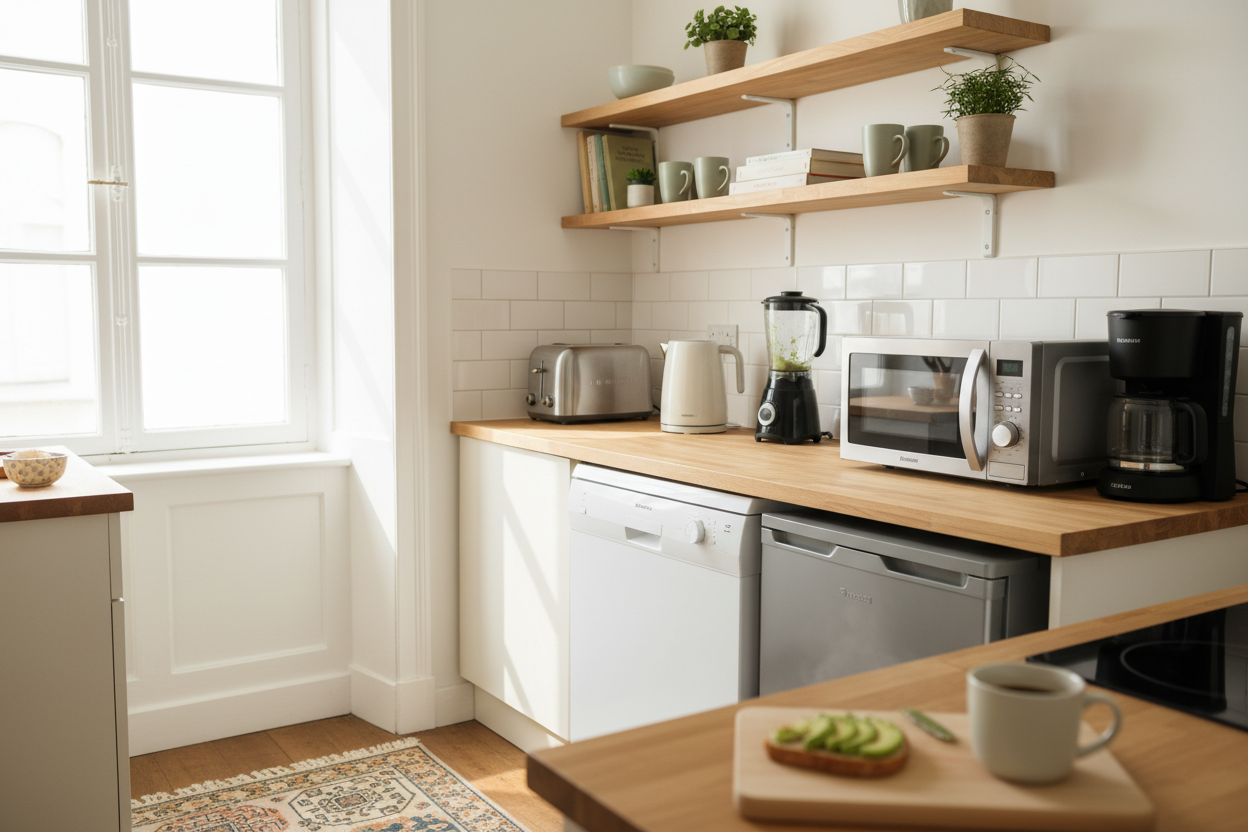
Small Kitchen Appliance Guide for Apartments, Rentals and Student Accommodation
Moving into an apartment, rented home or student accommodation often means working with a smaller kitchen, limited storage and shared facilities. The answer is not to fill every available corner with appliances. It is to choose a small number of products that suit the space and the way you actually cook, clean and live.
Before buying anything, check what is already supplied, read the accommodation rules and measure the available space carefully. A compact appliance is only useful if it fits comfortably, can be operated safely and earns its place on the worktop.
Check what is already provided
If you are renting privately in Ireland, your home should generally include essential cooking, refrigeration and laundry facilities under the country’s minimum standards for rented accommodation. These include cooking facilities, a fridge-freezer, a microwave and access to laundry equipment, although alternative requirements can apply to certain tenancy types.
Student residences and purpose-built accommodation may have their own rules. Some provide fully equipped shared kitchens, while others restrict which electrical cooking appliances can be brought into bedrooms or communal areas.
Before shopping, confirm:
- Which appliances are already supplied
- Whether personal cooking appliances are permitted
- Where those appliances may be used
- Whether there are wattage or electrical-safety restrictions
- Who is responsible if a supplied appliance stops working
- Whether housemates already own items that can be shared
This simple check can prevent duplicate purchases and save valuable cupboard and worktop space.
Measure usable space, not just the empty gap
Product dimensions tell you whether an appliance can physically fit, but they are only the starting point. You also need room to open doors, remove baskets, fill water tanks and let heat escape safely.
Measure the width, height and depth of the intended location. Then consider:
- The space required around the appliance under the manufacturer’s instructions
- Whether an air fryer drawer or microwave door can open fully
- Whether overhead cupboards will be exposed to steam or heat
- How close the nearest suitable wall socket is
- Where the cable will sit without crossing a sink, hob or walkway
- Where the appliance will be stored when it is not in use
Remember to measure the appliance in its operating position. An air fryer may have a relatively narrow body but need considerably more space in front when its drawer is removed.
Choose appliances by the job they perform
Small kitchens benefit from appliances that solve frequent problems. Start with the jobs you do every day, such as reheating food, preparing quick meals or cleaning hard floors. Products for occasional recipes can normally wait.
1. Microwave: the practical all-rounder
A microwave is useful for reheating meals, defrosting ingredients and preparing simple food quickly. If one is not already supplied, compare the appliance’s external dimensions as carefully as its internal capacity.
A compact solo microwave is usually the simplest choice for reheating and defrosting. A grill model can also brown certain foods, while a combination microwave adds convection cooking and may replace some of the functions of a conventional oven.
When comparing microwaves at Euronics, look at:
- External dimensions: Check the full width, depth and height rather than relying on capacity alone.
- Internal capacity: Make sure your usual plates and containers will fit.
- Turntable size: A large dinner plate should rotate without catching the sides.
- Power: Higher wattage can reduce cooking time, but always follow the timings provided for the model.
- Controls: Straightforward dials can be convenient, while digital models may offer timers and automatic programmes.
- Cleaning: A smooth, accessible interior is particularly useful in a shared kitchen.
A combination microwave can make sense where oven space is limited, but only if its additional cooking functions will be used regularly.
2. Air fryer: match the capacity to the household
An air fryer can be useful for cooking smaller portions without using a full-size oven. However, larger dual-drawer models can occupy a substantial amount of worktop space.
For one or two people, a compact single-drawer model may be easier to store and clean. A larger or dual-zone appliance is better suited to households that regularly cook several portions or want to prepare two foods at different settings.
Before choosing from the Euronics air fryer range, consider:
- How many portions you normally prepare
- The appliance’s full worktop footprint
- Space in front for removing the basket or drawer
- Whether removable parts are easy to wash
- Where the appliance can cool before it is stored
- Whether your tenancy or accommodation permits it
Do not choose capacity purely on the number printed on the box. Basket shape also matters: a wider cooking area may be more practical for some foods than a deep but narrow drawer.
3. Kettle and toaster: buy for the way you use them
Kettles and toasters are everyday appliances, but they can quickly consume a surprising amount of worktop space. In shared accommodation, one set is usually enough for the whole kitchen.
For a kettle, consider capacity, minimum fill level, weight when full, automatic switch-off and how easily the limescale filter can be cleaned. Boiling only the water you need can also avoid unnecessary electricity use.
For a toaster, check whether you normally use standard sliced bread, thicker bread or larger items. Slot width, browning controls, reheat settings and removable crumb trays can be more useful than decorative features.
Browse kettles and toasters, but agree on colour, size and budget with housemates before buying a shared set.
4. Food-preparation appliances: favour versatile designs
Blenders, mixers and food processors can save preparation time, but accessories and bowls require storage. In a compact kitchen, a smaller product that handles several regular jobs may be more practical than a large appliance with attachments that rarely leave the cupboard.
Useful small-space options include:
- A hand blender with a detachable shaft
- A personal blender with a cup that doubles as a drinking container
- A compact food processor for chopping, grating and slicing
- A multi-function appliance that replaces two or more separate products
Check which accessories are included and where they will be stored. The Euronics food-preparation range includes compact and multi-function options, but the best choice is the one that matches meals you already prepare.
5. Vacuum cleaner: storage can matter as much as suction
Floorcare is easy to overlook when moving, particularly if the home has a mixture of carpet, hard flooring and stairs. A vacuum should be suitable for those surfaces while remaining easy to store.
A cordless vacuum cleaner can be convenient in a compact apartment because it is manoeuvrable and often has a smaller storage footprint. Check where it will charge, whether the charging point needs to be mounted and whether the quoted runtime is appropriate for the area you need to clean.
A compact cylinder model may provide a good alternative if you have a suitable cupboard and prefer not to manage battery charging. Compare both formats in the wider vacuum cleaner range.
Whichever style you choose, consider:
- Storage dimensions
- Weight and ease of carrying
- Floor-head size
- Filtration
- Bin or bag capacity
- Replacement filters, bags and other ongoing costs
- Noise in a shared home
Three sensible small-space setups
For a shared student kitchen
- Use the supplied major appliances first
- Agree on shared purchases before anyone spends money
- Choose one kettle and toaster rather than several
- Consider a compact air fryer only if it is permitted and genuinely needed
- Keep personal food-preparation appliances small enough to store in a cupboard
For a studio apartment
- Prioritise quiet appliances where the kitchen and sleeping area share one room
- Consider a combination microwave if oven capacity is limited
- Choose an air fryer or countertop cooker based on your usual meals rather than buying both
- Look for a vacuum that can be stored vertically or in a narrow cupboard
- Avoid leaving the entire worktop permanently occupied
For a compact family rental
- Choose capacity for the whole household rather than the smallest available appliance
- Prioritise easy-clean surfaces and dishwasher-safe removable parts where appropriate
- Use vertical storage for accessories where it can be done safely
- Check that doors and drawers can open without blocking busy walkways
- Keep frequently used appliances accessible and store occasional ones elsewhere
Do an electrical-safety check
Irish electrical products should be suitable for the standard three-pin wall socket. The Competition and Consumer Protection Commission advises shoppers to buy electrical products from reputable retailers, check for required safety information and avoid overloading sockets.
The CCPC also warns against connecting extension leads together. This practice, sometimes called daisy-chaining, can create a fire risk. Keep the number of devices connected to one socket to a minimum and follow the instructions supplied with each appliance.
In a small kitchen:
- Never use an appliance with a damaged plug or cable
- Keep cables and electrical connections away from water
- Do not position hot appliances directly beneath unsuitable surfaces
- Allow ventilation space specified by the manufacturer
- Do not store an appliance until it has cooled
- Register products with the manufacturer where registration is available
- Check the CCPC website if you become aware of a possible product recall
Small-kitchen buying checklist
Before placing an order, ask the following questions:
- Is this appliance already supplied?
- Is it allowed under my tenancy or accommodation rules?
- Will I use it at least weekly?
- Does it replace another appliance or duplicate one?
- Have I measured its full operating space?
- Is there a suitable socket nearby?
- Can doors, lids and drawers open fully?
- Where will it be stored?
- How difficult will it be to clean?
- Have housemates agreed to any shared purchase?
Make every appliance earn its space
A well-planned small kitchen does not need to feel limited. Start with the equipment already provided, identify the jobs that matter most and choose compact appliances that will be used regularly.
Measure carefully, check accommodation rules and compare the complete cost, including accessories and replacement parts. When you are ready to shop, Euronics offers a broad selection of microwaves, air fryers, food-preparation appliances and vacuum cleaners for different spaces and households.
